Solar panels come in a variety of types, each designed to cater to different energy needs, budgets, and installation environments. Understanding the available options helps you make an informed decision when considering a solar setup for your home or business.
1. Monocrystalline Solar Panels
Monocrystalline panels are made from a single crystal of pure silicon, giving them their distinctive black color and premium look. Known for their high efficiency—typically between 18–22%—these panels are among the most efficient and long-lasting, often performing well for 25 years or more.
They’re ideal for rooftops with limited space, making them a great choice for urban homes or offices where every square meter counts. While the upfront cost is higher compared to other types, their superior energy output and longevity usually justify the investment over time.
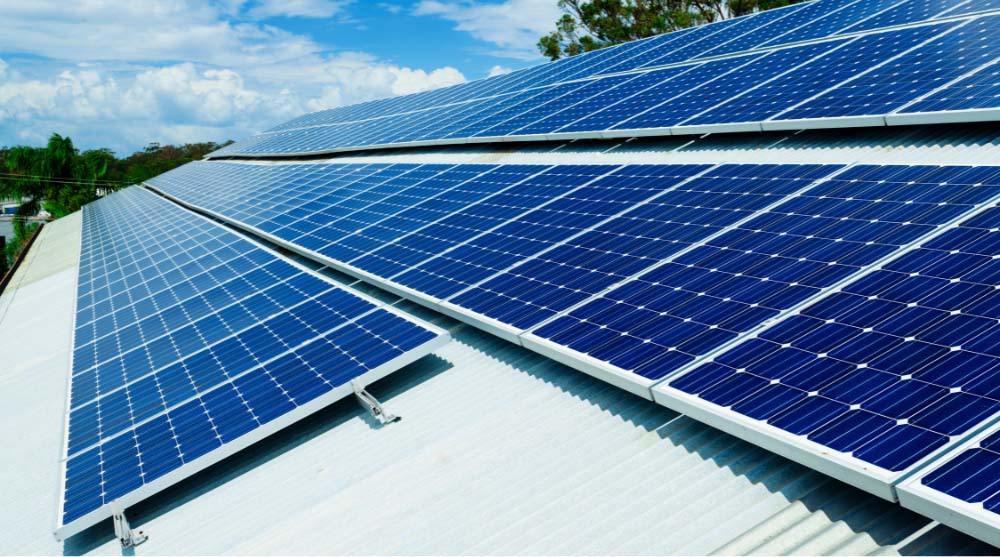
2. Polycrystalline Solar Panels
Polycrystalline panels are manufactured by melting together multiple silicon crystals, resulting in a blue, speckled texture. Their efficiency ranges from 15–17%, slightly lower than monocrystalline panels, but they remain one of the most affordable and widely used options.
They’re perfect for installations where space isn’t a constraint—such as large rooftops, farms, or industrial setups. With a lifespan of 20–25 years, they offer excellent durability and performance in most Indian weather conditions. Though they’re less efficient in converting sunlight, their lower cost makes them attractive for budget-conscious consumers.
3. Thin-Film Solar Panels
Thin-film panels are made by layering photovoltaic materials—such as cadmium telluride or amorphous silicon—onto a flexible backing. This gives them a lightweight, bendable design that’s ideal for unconventional surfaces like curved roofs or portable applications.
With efficiency levels around 10–12%, they don’t perform as well as crystalline silicon panels, but they shine in commercial or industrial use cases where flexibility and scalability matter. Their shorter lifespan and lower efficiency make them less common for residential homes, though they remain a cost-effective solution for large-scale projects.
4. Heterojunction (HJT) and TOPCon Panels — The High-Efficiency Standard
The solar industry is rapidly evolving, and two advanced technologies—Heterojunction (HJT) and TOPCon—are setting new benchmarks for performance and reliability.
HJT (Heterojunction) panels combine crystalline and amorphous silicon layers, significantly improving light absorption and maintaining cooler operation. This hybrid design pushes efficiency beyond 25%, making them one of the most powerful options available.
TOPCon (Tunnel Oxide Passivated Contact) panels use an ultra-thin passivation layer that reduces charge recombination, enhancing both energy efficiency and lifespan.
Benefits of HJT and TOPCon Panels:
Highly reliable and durable
Perform exceptionally well in hot climates
Suitable for residential, commercial, and utility-scale installations
These technologies represent the next step forward in solar innovation—offering better performance, longer life, and higher returns on investment.
5. Advanced and Specialized Solar Technologies
In addition to mainstream options, several advanced panel types are expanding solar’s possibilities:
Bifacial Panels: Capture sunlight from both sides, increasing energy generation by up to 20%. Ideal for open or reflective surfaces such as solar farms.
PERC Panels (Passivated Emitter Rear Cell): Add a special layer at the back of cells to boost light absorption and efficiency, especially under high temperatures or partial shade.
DSSC and OPV Panels: Lightweight, flexible, and even semi-transparent—these dye-sensitized and organic photovoltaic panels are still emerging technologies, mainly used in research or small-scale design applications.
Perovskite and CPV Panels: Highly experimental options that show remarkable lab efficiencies but are not yet widely available due to stability challenges.
Choosing the Best Solar Panel for You
For most Indian homes, monocrystalline panels remain the top choice due to their excellent balance of efficiency, durability, and sleek aesthetics.
If you’re working with a tighter budget and have ample roof space, polycrystalline panels are a solid option.
For specialized or large-scale installations, thin-film, PERC, bifacial, or the new HJT/TOPCon technologies can deliver even higher performance depending on site conditions and budget.
Ultimately, consulting with a professional solar installer is essential—they can assess your energy requirements, climate, and available space to recommend the most efficient and cost-effective system for your needs.